

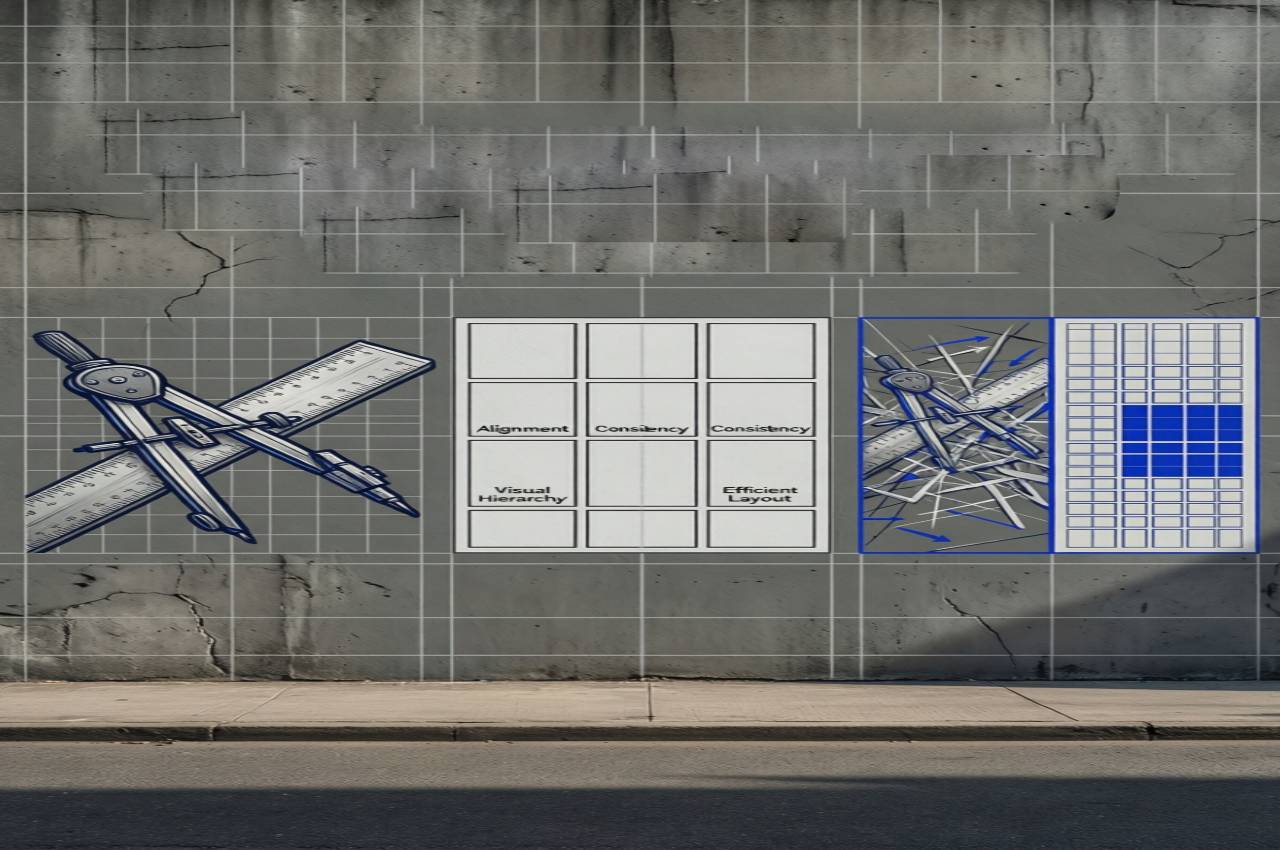
Grid systems are one of the most important foundations in modern design. They help designers organize content, create visual harmony, and deliver better user experiences across digital and print platforms. Whether in web design, UI/UX, branding, or editorial layouts, grids quietly shape how information is perceived and understood.
Understanding Grid Systems
Grid systems are invisible frameworks made of columns, rows, and margins that structure a design. They guide where elements should be placed without dictating creativity. Designers rely on grids to balance freedom with consistency.
Core Structure of Grids
The structure defines columns, gutters, and margins that align content precisely. This ensures visual order even in complex layouts.
Why Grids Feel Natural
Grids reflect how the human eye scans information, making designs easier to read and visually comfortable.
The Role of Grids in Visual Hierarchy
Grids help designers control attention and emphasize what matters most. They define relationships between headlines, images, and body text clearly.
Guiding the Viewer’s Eye
By aligning elements, grids create predictable reading paths that improve comprehension.
Balancing Emphasis and Clarity
Grids allow important elements to stand out without overwhelming the rest of the layout.
Grids in Digital Design
In web and app design, grids ensure consistency across screens and devices. They are essential for responsive and scalable interfaces.
Responsive Layout Foundations
Grids adapt content smoothly across desktop, tablet, and mobile screens.
Consistency Across Interfaces
Design systems rely on grids to maintain uniform spacing and alignment across products.
Grids in Print and Editorial Design
Before digital design, grids were the backbone of magazines and newspapers. They remain essential for structured storytelling.
Editorial Flow Control
Grids help editors manage text-heavy layouts while maintaining readability.
Visual Rhythm in Print
Consistent spacing creates a rhythm that keeps readers engaged page after page.
Creativity Within Grid Systems
Grids do not limit creativity; they enhance it. Designers often break grids intentionally to create impact.
Controlled Rule-Breaking
Breaking a grid works best when the underlying structure is strong and consistent.
Design Confidence Through Structure
Knowing the grid allows designers to experiment without losing balance.
Grid Systems in Branding and Identity
Strong brands rely on grids to maintain visual consistency across all touchpoints.
Brand Recognition and Order
Consistent layouts reinforce brand trust and recognition.
Scalability Across Media
Grids make it easier to adapt branding from digital screens to physical materials.
Case Study: Grid Systems in Google Material Design
Google’s Material Design is a real-world example of grid systems at scale. It uses an 8-point grid to standardize spacing across all interfaces.
The Problem Google Faced
Design inconsistency across devices and platforms created usability issues.
The Grid-Based Solution
By adopting a unified grid, Google improved usability, development speed, and visual coherence across products.
Statistics
Accurate data shows why grid systems are widely adopted in professional design:
- 72% of UX designers use grid systems in every project to ensure layout consistency
- Websites designed with structured grids show up to 20% higher readability scores
- Responsive grid-based designs reduce layout-related development time by 30%
- 85% of professional designers consider grids essential for scalable design systems
- Grid-aligned interfaces improve task completion speed by 15% in usability tests
- Editorial layouts using grids increase reading retention by approximately 25%
- Design teams using shared grid systems report 40% fewer revision cycles
The Most Common Mistakes Designers Make with Grids
Even powerful tools can be misused if not understood properly.
Over-Rigid Application
Strict adherence can make designs feel mechanical and lifeless.
Ignoring Content Needs
Forcing content into a grid without flexibility harms readability and user experience.
Frequently Asked Questions
Are grid systems necessary for every design project?
Not always, but they significantly improve consistency, especially in complex or scalable designs.
Do grids limit creative freedom?
No. They provide a foundation that actually makes creativity more intentional and effective.
What is the most popular grid system in web design?
The 12-column grid is widely used due to its flexibility and responsiveness.
Can beginners use grid systems effectively?
Yes. Grids are especially helpful for beginners to understand spacing and alignment principles.
Are grids only for visual designers?
No. Developers, content designers, and product teams also rely on grids for structure and consistency.
Conclusion
Grid systems are a silent but powerful force behind successful design. They enhance clarity, usability, and visual harmony while supporting creativity rather than suppressing it. From digital interfaces to editorial layouts and global design systems, grids enable designers to communicate ideas more effectively and consistently. Mastering grid systems is not about following rules blindly, but about understanding structure deeply enough to use it with confidence and purpose. delivered clearly and effectively. When applied thoughtfully, contrast transforms design from decorative to purposeful. Mastering contrast is essential for any professional digital publication.
