

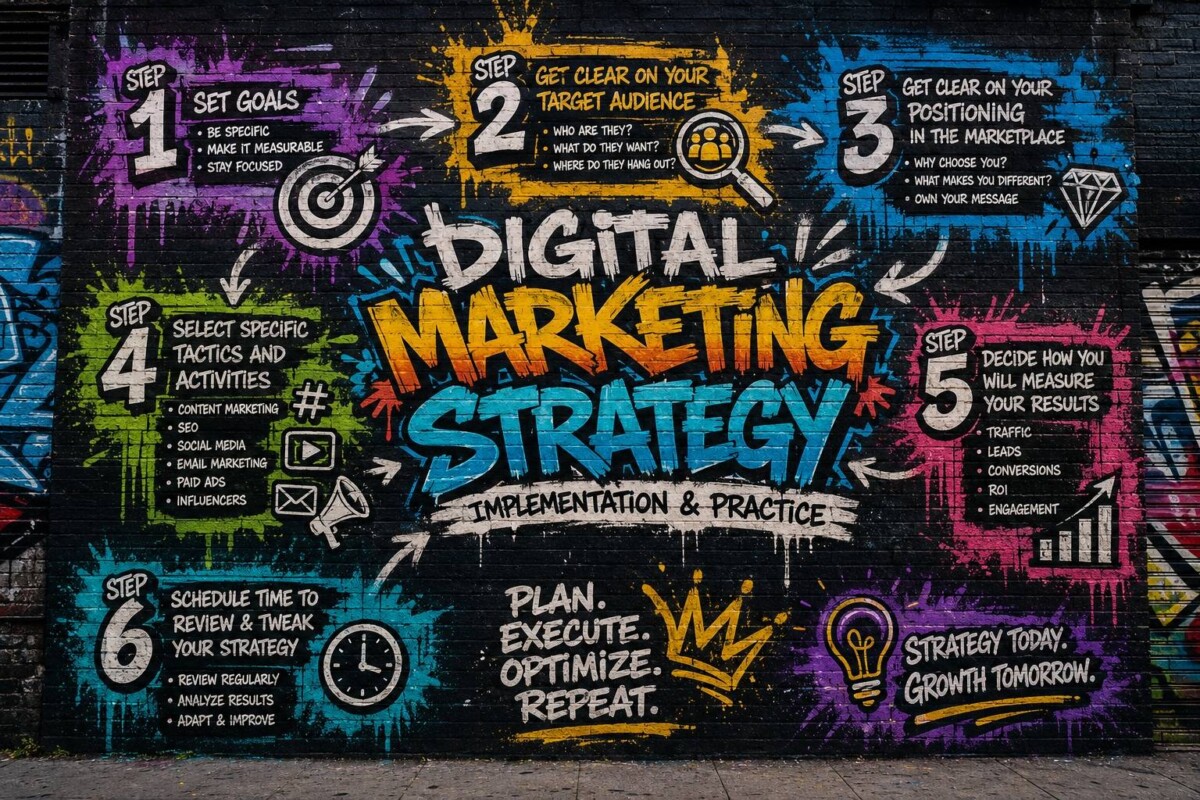
The “Stop Posting Random Stuff and Hoping for Miracles” Guide
Look, a lotta businesses treat digital marketing like a drunk guy playing darts blindfolded in a garage.
They post a blurry Canva graphic.
Throw $20 into ads.
Add 47 hashtags.
Then sit there wondering why nobody bought their “premium handcrafted keto protein socks.”
That’s not strategy.
That’s emotional damage with Wi-Fi.
Real digital marketing strategy is simple:
Know what you want.
Know who wants it.
Know why they should care.
Then repeat what works until your competitors start crying in LinkedIn posts.
So let’s break this thing down American street-style.
Step 1: Set Goals
If your marketing goal is “get more customers,” congratulations.
That’s like telling a gym trainer:
“I wanna… be healthier.”
Cool.
What does that even mean?
Your goals gotta be specific.
Bad Goal:
- “Grow my business.”
Good Goals:
- Get 100 leads this month.
- Increase online sales by 20%.
- Reach 10,000 email subscribers.
- Reduce customer acquisition cost.
- Get more booked calls.
- Stop your cousin Kevin from running your Facebook ads.
A real goal gives your marketing direction.
Without goals, your business turns into:
- random TikToks
- confused Instagram captions
- panic-boosted Facebook posts at 2 AM
And nobody wants that life.
Step 2: Get Clear on Your Target Audience
This part right here?
This is where most businesses completely lose the plot.
They say:
“Our product is for everyone.”
No.
Pizza is for everyone.
Your software for dental inventory management is not.
You gotta know:
- Who they are
- What they want
- What annoys them
- What keeps them awake at night scrolling TikTok like a raccoon eating gas station snacks
Ask yourself:
- Are they business owners?
- Moms?
- Gamers?
- Corporate zombies?
- Startup founders surviving on coffee and delusion?
Then learn:
- what apps they use
- what influencers they trust
- how they talk
- what words they actually use
Because here’s the secret:
People buy from brands that sound like they understand them.
Nobody trusts a company that talks like a malfunctioning HR department.
Step 3: Get Clear on Your Positioning in the Marketplace
Translation:
Why should people pick YOU instead of the other 9 million businesses yelling online?
Your positioning is your identity.
Are you:
- the cheap option?
- the luxury option?
- the funny brand?
- the expert?
- the fast one?
- the “we answer emails before the heat death of the universe” company?
You need one clear message.
Not:
“We provide innovative customer-centric solutions leveraging scalable synergy.”
Brother… nobody knows what that means.
Say:
- “We build websites fast.”
- “We help gyms get more members.”
- “We make accounting less painful.”
- “We help small businesses stop wasting money on ads.”
Clear wins.
Confusing loses.
Every single time.
Step 4: Select Specific Tactics and Activities
Now we stop talking and start cooking.
This is where strategy becomes action.
Pick tactics based on:
- your audience
- your budget
- your goals
Not because some 19-year-old crypto guy rented a Lamborghini and screamed about “funnels.”
Examples:
Content Marketing
Write blogs.
Post videos.
Teach stuff.
Be useful.
Crazy concept, I know.
SEO
Help Google understand your website so you stop depending entirely on ads and caffeine.
Social Media
Post content people actually wanna see.
Not:
“Happy Wednesday from the team!!!”
Nobody cares, Janet.
Email Marketing
Still one of the most profitable channels on Earth.
Because unlike social media:
your email list belongs to YOU.
Paid Ads
Fast traffic.
Fast data.
Fast way to burn money if you have no strategy.
Influencer Marketing
Basically digital word-of-mouth with ring lights.
The key is consistency.
Most businesses quit marketing right before things start working.
They post for 8 days then disappear like a Netflix show after season one.
Step 5: Decide How You Will Measure Your Results
If you don’t measure your marketing…
you’re basically gambling in business casual clothes.
Track stuff like:
- website traffic
- leads
- conversion rates
- sales
- click-through rates
- email open rates
- return on ad spend
- cost per lead
Data tells the truth.
Your feelings do not.
You may LOVE a campaign that got zero sales.
Meanwhile the ugly email with the terrible subject line:
“hey quick question”
Somehow makes $40,000.
Marketing is weird like that.
Use tools like:
These tools help you stop guessing and start scaling.
Step 6: Schedule a Time to Review and Tweak Your Digital Marketing Strategy
Here’s the brutal truth:
The internet changes every five minutes.
One day Instagram loves reels.
Next week it wants carousels.
Then suddenly everybody’s pretending newsletters are sexy again.
Your strategy is not a tattoo.
It’s more like a GPS.
You adjust when traffic changes.
Review your strategy monthly or quarterly:
- What worked?
- What flopped?
- What got engagement?
- What got ignored harder than a Terms & Conditions page?
Then optimize.
Smart marketers adapt fast.
Bad marketers keep doing the same thing while whispering:
“maybe the algorithm hates me.”
Put Your Digital Marketing Strategy Into Practice
Here’s the difference between successful businesses and struggling businesses:
Successful businesses execute.
That’s it.
Because honestly?
Most people already know what they SHOULD do.
They just:
- overthink
- procrastinate
- redesign logos for the 400th time
- watch productivity videos instead of producing anything
A decent strategy executed consistently beats a perfect strategy sitting in a Google Doc collecting dust.
Start ugly.
Start small.
Start now.
The businesses winning online aren’t magical geniuses.
They just kept showing up while everyone else got distracted.
7 Statistics About Digital Marketing
1. Email marketing delivers one of the highest ROIs in digital marketing
Businesses often earn around $36 for every $1 spent on email marketing.
2. Most online experiences begin with a search engine
Search engines still dominate customer discovery behavior.
3. Video content massively increases engagement
Short-form videos consistently outperform many traditional content formats.
4. Mobile traffic dominates the internet
More than half of global web traffic now comes from mobile devices.
5. Consumers trust online reviews almost as much as personal recommendations
Social proof can directly impact conversion rates.
6. Businesses that blog consistently generate more leads
Content marketing compounds over time like digital real estate.
7. Retargeting ads significantly improve conversion rates
People rarely buy the first time they see your offer.
Retargeting helps bring them back before they forget you exist.
