

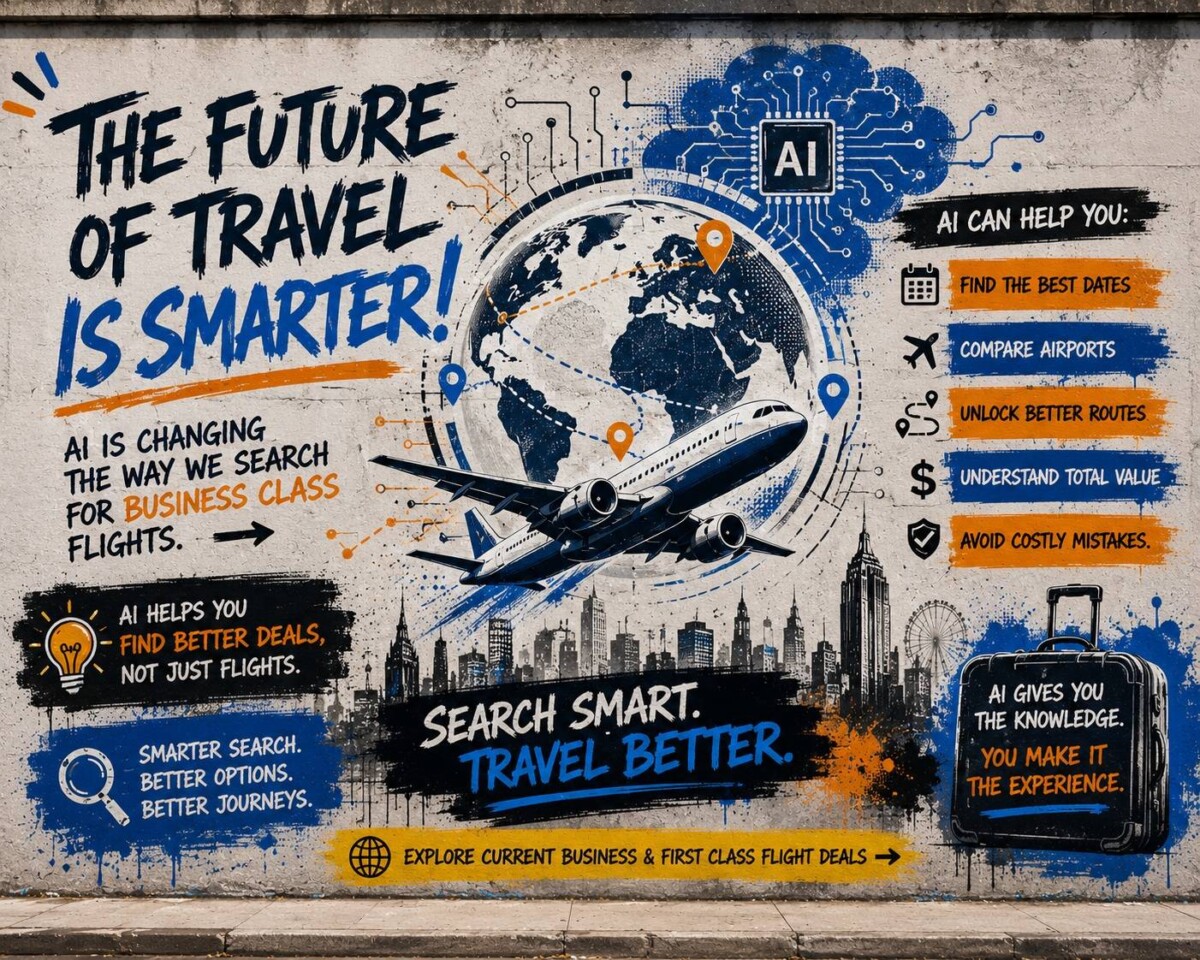
There was a time when finding a good business-class fare meant opening a dozen browser tabs, checking airline websites, comparing departure times, and then doing it all over again the next morning.
That era is changing.
Artificial intelligence is beginning to reshape the way travelers search, compare, and plan expensive international trips. And while AI cannot magically manufacture a cheap business-class ticket, it can make the process of finding one considerably smarter.
The real question for travelers in 2026 isn’t whether AI can book a flight.
It’s whether we’re finally getting better at finding the right flight before someone else does.
AI Is Becoming the New Travel Research Assistant
Ask a traditional search engine for a business-class flight and you’ll typically get a list of websites, advertisements, airline pages, and booking platforms.
Ask an AI assistant the same question, and the conversation can be much more specific:
I need to fly from New York to London next month. I can leave anytime between Tuesday and Thursday, I’d prefer a nonstop flight, and I want to keep the business-class fare as low as possible.
That’s a fundamentally different way to search.
Instead of starting with a destination and a fixed set of filters, travelers can increasingly describe what they actually want and use AI to help organize the options.
But there’s an important catch.
AI can help you think through the search. It doesn’t mean every fare it mentions is still available, accurate, or the best price.
That’s why the final step still matters: check the live fares and booking options yourself.
The smarter way to use AI
Think of AI as the research assistant sitting beside you—not the travel agent holding your credit card.
Use it to:
- identify flexible travel dates;
- compare alternative airports;
- suggest reasonable connecting cities;
- explain business-class fare differences;
- build a shortlist of possible itineraries;
- identify questions you should ask before booking.
Then verify the actual fare, schedule, baggage allowance, cancellation rules, and availability through a live flight search.
That combination—AI for intelligence, live search for verification—is where things get interesting.
The Business-Class Search Is Different
For economy travelers, saving $40 on a ticket may be nice.
For business-class travelers, the difference can be hundreds—or sometimes thousands—of dollars.
That makes flexibility much more valuable.
A traveler searching only:
New York → London, June 15
may miss a better option by searching too narrowly.
An AI-assisted approach might instead explore:
New York → London, June 13–17
and consider:
- JFK vs. Newark;
- nonstop vs. one-stop;
- morning vs. evening departures;
- nearby arrival airports;
- different airlines;
- alternative return dates.
The goal isn’t simply to find a business-class ticket.
It’s to find the combination of price, schedule, comfort, and flexibility that makes the ticket worth buying.
Before You Book: Check the Current Business-Class Options
If you’re researching an international business-class trip, it’s worth comparing current fares after you’ve narrowed down your preferred route and dates.
[Check current Business & First Class flight deals → Affiliate Link]
This link may earn the publisher a commission at no additional cost to you.
AI Won’t Always Find the Cheapest Fare
This is where travelers need to be careful.
AI systems can be extremely useful for research, but airfare is a live market. Prices and availability can change quickly, and an AI-generated answer isn’t necessarily a live quotation.
So don’t ask AI:
What’s the cheapest business-class ticket available right now?
and immediately pull out your credit card.
Instead ask:
What are the best ways to search for a business-class flight from New York to Tokyo during this date range, and what variables should I compare?
That’s a much better use of the technology.
The AI gives you the strategy.
The live booking search gives you the price.
And the traveler makes the final decision.
5 Ways AI Can Help You Find Better Business-Class Fares
The biggest advantage of using AI to plan a premium trip isn’t that it somehow knows a secret airfare nobody else can see.
It’s that AI can help you ask better questions.
And with business-class tickets, better questions can translate into dramatically better choices.
1. Give AI a Flexible Date Range
Instead of asking:
“Find me a business-class flight from New York to Paris on September 10.”
try:
“I can travel between September 8 and September 14. Find the best business-class options and explain which dates appear most attractive and why.”
That small change gives the search more room to work.
Even if you ultimately book on September 10, knowing what happens on the surrounding dates gives you something valuable: context.
2. Ask About Alternative Airports
Your preferred airport isn’t always the airport with the best fare.
A traveler in New York, for example, may naturally search JFK first. But depending on the itinerary, Newark could produce a better combination of schedule and price.
The same principle applies internationally.
AI can help you create a shortlist of:
- nearby departure airports;
- alternative arrival airports;
- nonstop alternatives;
- one-stop options worth considering.
You can then verify those options through live booking searches.
The point isn’t to make travel complicated.
It’s to avoid overlooking a better option simply because the search started with one airport.
3. Ask AI to Compare the Total Value, Not Just the Price
A $2,500 business-class ticket isn’t automatically better than a $2,700 ticket.
What if the cheaper fare has:
- a 10-hour connection;
- restrictive cancellation conditions;
- poor departure times;
- fewer baggage benefits;
- an inferior routing?
The extra $200 may suddenly look like money well spent.
That’s why one of the most useful prompts is:
“Compare these business-class options based on total travel time, connections, baggage, flexibility, cabin experience and price.”
AI is particularly useful here because it can organize a messy collection of information into something easier to evaluate.
4. Use AI to Build Your Search Strategy Before You Shop
This may be the most underrated use of AI.
Instead of immediately asking for a ticket, ask:
“I’m flying from Mumbai to London in October. What variables should I investigate before booking a business-class flight?”
The answer can become your checklist.
For example:
Dates → Airports → Airlines → Routing → Fare rules → Baggage → Seat → Cancellation → Final price
Now you’re not simply searching for the first attractive fare.
You’re evaluating the entire purchase.
And that’s particularly important when you’re spending several thousand dollars on an international ticket.
5. Let AI Find the Questions You Didn’t Think to Ask
This is where AI can become genuinely useful for experienced travelers.
After finding a potential itinerary, paste the important details into your AI assistant and ask:
“What am I missing before I book this business-class fare?”
The response may prompt you to investigate things you hadn’t considered:
- Is the connection long enough?
- Is the fare refundable?
- Does the ticket include checked baggage?
- Is the business-class segment actually operated in Business Class?
- Is there a mixed-cabin itinerary?
- What happens if the first flight is delayed?
- Are there airport or terminal changes?
AI doesn’t replace the booking process.
It makes you harder to fool during the booking process.
AI Search vs. Traditional Flight Search
There is also a fundamental difference between the two approaches.
Traditional approach
Destination → Dates → Filters → Results → Choose
AI-assisted approach
Goal → Constraints → Alternatives → Comparison → Verification → Choose
That difference may sound subtle.
It isn’t.
Traditional search is excellent when you already know exactly what you want.
AI becomes more useful when you’re not completely sure what you want yet.
And that describes a surprisingly large percentage of expensive international trips.
The Best Strategy May Be a Combination of Both
The smartest approach in 2026 isn’t necessarily:
AI vs. flight-search websites.
It’s:
AI + live flight search.
Use AI to determine:
What should I search for?
Use live booking tools to determine:
What’s actually available right now?
Travelers can also check current business class flight deals after narrowing down their preferred dates and routes.
Then compare the final options yourself.
For travelers considering Business or First Class, that workflow can save time while keeping an important human step in the process: making sure the fare you’re about to buy is actually the fare you think you’re buying.
One More Thing: Don’t Let AI Make the Final Decision
There is a temptation to treat an AI assistant as a personal travel agent.
That’s understandable-but risky.
Airfares change. Availability changes. Airline policies change. And information generated by an AI system can be incomplete or outdated.
So use AI for what it does best:
research, comparison, organization and questions.
Use live sources for:
current prices, availability and booking.
And use your own judgment for the final purchase.
For travelers who want to explore current Business and First Class options after doing their research, an affiliate flight-search option can be a useful next step:
The Bottom Line
AI isn’t going to make every business-class ticket cheap.
That’s not what makes it useful.
Its real advantage is helping travelers become better researchers.
A flexible date range.
An alternative airport.
A second routing.
A closer look at the fare rules.
A question you hadn’t thought to ask.
Sometimes, finding a better flight isn’t about finding a secret deal.
It’s about knowing where to look—and what to look for.
