

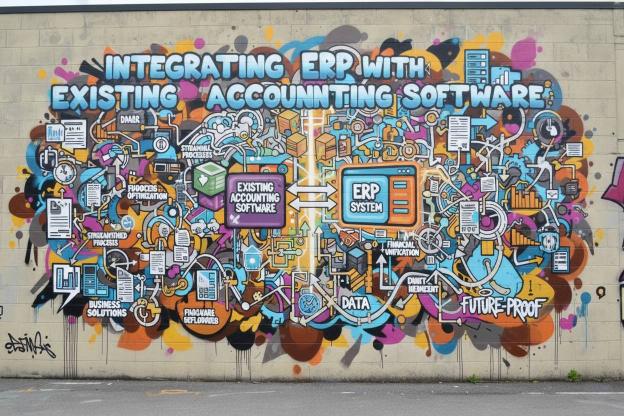
ERP and accounting integration connects core financial data with operational systems in real time.
This integration eliminates data silos between finance, sales, inventory, and procurement.
Businesses gain a unified source of truth for reporting and decision-making.
It also reduces manual data entry and reconciliation work for accounting teams.
Ultimately, integration improves accuracy, speed, and financial visibility across the organization.
ERP Core Functions
ERP systems manage multiple departments such as finance, HR, supply chain, and operations in one platform.
They centralize data to support enterprise-wide workflows and reporting.
Role of Accounting Software
Accounting software focuses on bookkeeping, compliance, invoicing, and financial statements.
Integration ensures these financial records stay synchronized with operational data.
Why Businesses Integrate ERP with Accounting Software
Companies integrate to support growth without increasing financial complexity.
As transaction volumes rise, disconnected systems become inefficient and error-prone.
Integration enables real-time financial insights instead of delayed monthly reports.
It also supports better compliance with tax and regulatory requirements.
For management, it delivers faster and more reliable financial intelligence.
Scalability Needs
Growing companies require systems that scale without constant manual intervention.
ERP integration allows accounting processes to grow alongside operations.
Operational Transparency
Executives gain visibility into costs, revenues, and margins across departments.
This transparency improves strategic planning and forecasting accuracy.
Key Integration Approaches
There are multiple ways to integrate ERP with existing accounting systems.
The right approach depends on budget, technical resources, and business complexity.
Some methods are faster to deploy, while others offer deeper customization.
Choosing the correct approach reduces long-term maintenance challenges.
A well-planned integration minimizes disruption to daily financial operations.
API-Based Integration
APIs enable real-time data exchange between ERP and accounting platforms.
They offer flexibility and are ideal for modern cloud-based systems.
Middleware Solutions
Middleware acts as a bridge between systems with different data structures.
This approach is useful when native integrations are not available.
Data Synchronization and Financial Accuracy
Accurate data synchronization is the backbone of successful integration.
It ensures that transactions appear consistently across all systems.
Without proper synchronization, reporting discrepancies can occur.
Integration improves audit readiness and financial controls.
It also supports faster period closing and reconciliations.
Real-Time Data Flow
Transactions update instantly across ERP and accounting platforms.
This reduces delays in financial reporting and analysis.
Data Validation Rules
Validation ensures that incorrect or duplicate data is not transferred.
It protects the integrity of financial records.
Security and Compliance Considerations
Financial data integration requires strong security controls.
ERP systems often handle sensitive accounting and payroll information.
Integration must comply with data protection and financial regulations.
Access control and encryption are essential safeguards.
Security planning reduces the risk of breaches and compliance penalties.
Role-Based Access
Users access only the financial data relevant to their roles.
This limits exposure to sensitive accounting information.
Regulatory Compliance
Integration supports compliance with standards like IFRS, GAAP, and VAT rules.
Automated audit trails improve regulatory reporting.
Challenges in ERP and Accounting Integration
Despite its benefits, integration comes with technical and operational challenges.
Legacy systems may lack modern integration capabilities.
Data mapping errors can lead to reporting inconsistencies.
User resistance can slow adoption across finance teams.
Proper planning helps mitigate these common obstacles.
Legacy System Limitations
Older accounting software may not support APIs or automation.
This increases customization and integration costs.
Change Management Issues
Employees may resist new workflows introduced by ERP integration.
Training is essential for successful adoption.
Real-World Case Study: Mid-Sized Manufacturing Company
A manufacturing firm using standalone accounting software struggled with delayed financial reports.
After integrating ERP with its accounting system, reporting time dropped significantly.
Inventory, sales, and finance data became fully synchronized.
The company improved cash flow visibility and reduced reconciliation errors.
Within one year, financial decision-making became faster and more data-driven.
Implementation Overview
The company used API-based integration with cloud ERP modules.
Data migration was completed in phases to reduce risk.
Business Impact
Month-end closing time was reduced by more than 40%.
Management gained real-time profit and cost analysis.
Measuring ROI and Business Performance
ERP integration delivers measurable financial and operational returns.
Businesses track ROI through efficiency gains and cost reductions.
Improved reporting accuracy reduces financial risks.
Automation frees accounting teams for higher-value work.
Performance metrics help justify integration investments.
Cost Reduction Metrics
Manual processing and error correction costs decline significantly.
Automation improves staff productivity.
Decision-Making Improvements
Real-time financial insights support faster strategic decisions.
Executives rely on accurate dashboards instead of static reports.
Statistics
• Over 70% of growing businesses integrate ERP with accounting to improve financial visibility.
• Companies with ERP integration reduce financial reporting errors by approximately 30%.
• Real-time ERP-accounting integration shortens month-end close by up to 50%.
• Nearly 60% of CFOs cite system integration as critical for financial scalability.
• Businesses using integrated ERP systems see a 20–25% improvement in operational efficiency.
• Data synchronization automation reduces manual accounting tasks by around 40%.
• Organizations with integrated financial systems are 2x more likely to meet compliance deadlines.
Frequently Asked Questions
Is ERP integration necessary if accounting software works well?
Yes, because accounting software alone lacks operational context and scalability for growing businesses.
How long does ERP and accounting integration take?
Depending on complexity, it can take from a few weeks to several months.
Can integration work with legacy accounting systems?
Yes, but it may require middleware or custom development.
Does integration increase cybersecurity risks?
When implemented correctly, it often improves security through centralized controls.
Is cloud ERP easier to integrate than on-premise ERP?
Cloud ERP generally offers faster and more flexible integration options.
The Most Common Mistakes in ERP Integration
Underestimating data migration complexity leads to inaccurate financial records.
Ignoring user training causes resistance and workflow disruptions.
Choosing integration tools without scalability planning creates future bottlenecks.
Failing to define clear financial workflows results in system confusion.
Lack of testing before launch increases post-integration issues.
Conclusion
Integrating ERP with existing accounting software is a strategic move for modern businesses.
It improves financial accuracy, operational efficiency, and decision-making speed.
Successful integration requires careful planning, secure architecture, and user training.
When done correctly, it transforms accounting from a reactive function into a strategic asset.
ERP integration ultimately supports sustainable growth and long-term financial control.
