

How Smart Startups Are Outsmarting Bigger Competitors with AI
Introduction
In today’s competitive business landscape, startups face a difficult challenge: building brand awareness, attracting customers, and generating revenue while operating with limited resources. A strong digital marketing strategy is no longer optional for startups—it is essential for survival and growth.
Digital marketing allows startups to compete with larger companies by reaching highly targeted audiences through cost-effective online channels. Whether through search engines, social media, email campaigns, or content marketing, startups can create meaningful customer relationships and scale faster than traditional marketing methods ever allowed.
Unlike established corporations with massive advertising budgets, startups must focus on smart execution, creativity, and data-driven decisions. The right strategy helps startups maximize every dollar spent, improve customer acquisition, and build long-term authority in their niche.
A successful startup marketing strategy is not simply about running ads or posting on social media. It involves understanding the target audience, identifying the right channels, creating compelling content, measuring performance, and continuously optimizing campaigns for better results.
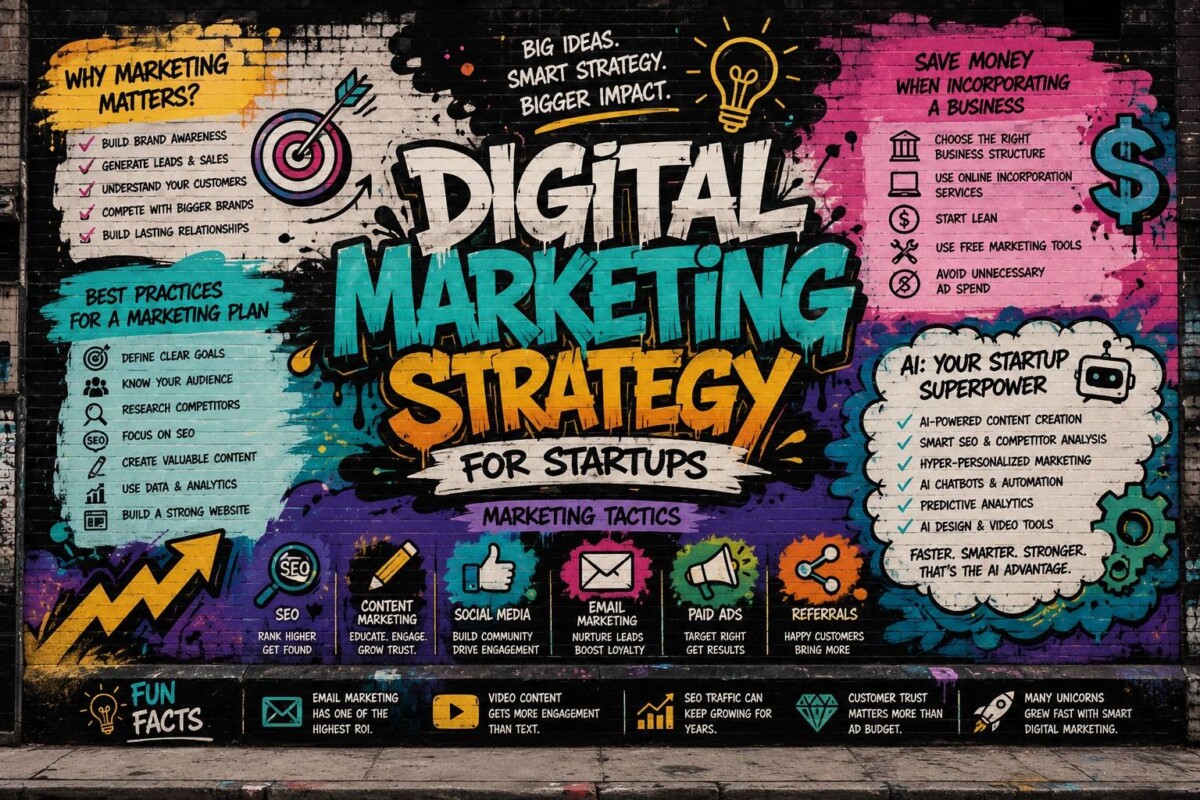
In this article, we will explore why marketing is critical for startups, the best practices for building an effective marketing plan, the most powerful marketing tactics for startup growth, methods for reducing business incorporation costs, and several interesting facts about startup marketing that many entrepreneurs overlook.
Why Is Marketing Important for Startups?
Building Brand Awareness
One of the biggest challenges for startups is visibility. Customers cannot buy from a company they do not know exists. Marketing introduces the startup to potential customers and helps establish a recognizable identity in the market.
Strong branding combined with effective marketing communication helps startups stand out from competitors and creates trust among customers. Even small startups can appear professional and credible with a consistent online presence.
Generating Leads and Sales
Marketing directly impacts revenue generation. Digital campaigns attract visitors, convert them into leads, and eventually turn them into paying customers.
Without a marketing strategy, startups often rely solely on referrals or luck, which limits scalability. Structured marketing creates predictable growth and allows startups to expand faster.
Understanding Customer Behavior
Marketing tools provide valuable insights into customer preferences, demographics, and buying behavior. Platforms like Google Analytics and Google Search Console help startups analyze traffic, understand user intent, and optimize marketing performance.
This data allows startups to make informed business decisions rather than relying on assumptions.
Competing With Larger Companies
Digital marketing levels the playing field. A startup with excellent SEO, engaging content, and smart advertising can compete against much larger brands.
Search engines and social media platforms reward relevance and creativity, not just advertising budgets. This creates opportunities for startups to gain market share quickly.
Building Customer Relationships
Modern marketing focuses heavily on engagement and trust. Startups that interact with customers through email newsletters, social media, and helpful content often build stronger customer loyalty.
Long-term customer relationships reduce acquisition costs and increase lifetime customer value.
Best Practices for Creating a Marketing Plan
Define Clear Business Goals
Every marketing plan should begin with clear objectives. Common startup goals include:
- Increasing website traffic
- Generating leads
- Growing email subscribers
- Increasing product sales
- Improving brand awareness
- Building social media engagement
Goals should be measurable and realistic.
Identify the Target Audience
Understanding the target audience is one of the most important elements of a successful strategy. Startups should analyze:
- Age groups
- Interests
- Pain points
- Geographic locations
- Online behavior
- Preferred platforms
Creating customer personas helps businesses produce more relevant marketing campaigns.
Conduct Competitor Research
Studying competitors reveals opportunities and weaknesses within the market. Tools like SEMrush and Ahrefs help startups analyze competitor keywords, backlinks, content strategies, and advertising campaigns.
Competitor analysis helps startups avoid mistakes and discover profitable marketing opportunities faster.
Focus on SEO From the Beginning
Search engine optimization is one of the most cost-effective long-term strategies for startups. Ranking on search engines can generate free traffic for years.
Important SEO practices include:
- Keyword research
- Technical optimization
- Mobile-friendly design
- Fast loading speed
- High-quality content creation
- Internal linking
- Building backlinks
SEO takes time, but the long-term return on investment is extremely high.
Create Valuable Content
Content marketing helps startups establish authority and attract organic traffic. Useful content includes:
- Blog articles
- Tutorials
- Case studies
- Videos
- Infographics
- Industry guides
High-quality content builds trust and improves SEO performance simultaneously.
Use Data and Analytics
Marketing decisions should be based on real performance data. Startups should continuously monitor:
- Traffic sources
- Conversion rates
- Customer acquisition costs
- Bounce rates
- Engagement metrics
- Return on advertising spend
Data-driven marketing improves efficiency and reduces wasted spending.
Build a Strong Website
A startup’s website is often the first impression customers receive. A professional website should include:
- Fast loading speed
- Mobile responsiveness
- Clear navigation
- Strong calls-to-action
- Trust indicators
- SEO optimization
Platforms like WordPress, Shopify, and Webflow provide powerful website-building solutions for startups.
Marketing Tactics for Startups
Search Engine Optimization (SEO)
SEO remains one of the best growth channels for startups. Organic traffic generates sustainable visitors without ongoing advertising costs.
Startups should target long-tail keywords because they are often easier to rank for and have higher conversion intent.
Example:
Instead of targeting:
- “digital marketing”
A startup could target:
- “digital marketing strategy for SaaS startups”
- “affordable digital marketing services for startups”
Long-tail keywords usually have lower competition and better conversion rates.
Content Marketing
Educational content positions startups as industry experts. Consistent blogging improves search rankings and attracts targeted traffic over time.
Content also supports social media, email campaigns, and backlink generation.
Social Media Marketing
Social platforms help startups build communities and interact directly with customers.
Important platforms include:
- LinkedIn for B2B startups
- Instagram for visual brands
- TikTok for younger audiences
- Facebook for broader audience targeting
- X (Twitter) for real-time engagement
Consistency and authenticity are critical for social media success.
Email Marketing
Email marketing remains one of the highest ROI channels available. Startups can nurture leads, promote products, and maintain customer relationships through personalized campaigns.
Popular email platforms include:
Influencer Marketing
Collaborating with niche influencers can significantly increase brand visibility. Micro-influencers are often more affordable and provide higher engagement rates than celebrity influencers.
Startups should focus on influencers whose audiences closely match their target customers.
Paid Advertising
Paid advertising allows startups to generate traffic quickly.
Popular advertising platforms include:
Small startups should begin with highly targeted campaigns and modest budgets while testing different creatives and audiences.
Referral Programs
Referral marketing encourages existing customers to recommend the startup to others. Referral incentives can significantly reduce customer acquisition costs.
Dropbox became one of the most famous examples of successful referral marketing by offering free storage for referrals.
How to Save Money When Incorporating a Business
Choose the Right Business Structure
Different business structures have different costs and tax implications. Entrepreneurs should compare:
- Sole proprietorship
- LLC
- Corporation
- Partnership
Choosing the correct structure from the beginning can reduce legal and tax expenses.
Use Online Incorporation Services
Online services simplify the incorporation process at lower costs than traditional legal firms.
Popular platforms include:
These services often include document preparation, filing assistance, and compliance support.
Start Lean
Many startups overspend during the early stages. Instead of renting expensive offices or hiring large teams immediately, startups should focus on lean operations.
Remote work, freelancers, and cloud-based software significantly reduce startup expenses.
Use Free Marketing Tools
Many powerful marketing tools offer free plans for startups, including:
- Canva for graphic design
- HubSpot CRM for customer management
- Trello for project management
- Google Workspace for collaboration
Using free or low-cost software reduces operational costs significantly.
Avoid Unnecessary Advertising Spending
Many startups waste money on untargeted ads. Proper audience research and conversion tracking prevent budget loss.
Testing campaigns with small budgets before scaling is a smarter strategy.
The AI Revolution: How Smart Startups Are Outsmarting Bigger Competitors
Artificial Intelligence is rapidly transforming the way startups build and execute digital marketing strategies. What once required large teams, expensive agencies, and months of research can now be achieved faster, smarter, and at a fraction of the cost through AI-powered tools and automation.
For startups with limited budgets and resources, AI has become one of the most powerful competitive advantages available.
AI-Powered Content Creation
Modern AI tools can help startups generate:
- Blog articles
- Product descriptions
- Social media captions
- Email campaigns
- Video scripts
- Ad copy
- SEO outlines
Platforms like ChatGPT, Jasper AI, and Copy.ai allow startups to produce high-quality content much faster than traditional workflows.
This dramatically reduces content production costs while increasing publishing speed.
AI and SEO Optimization
AI tools now help startups discover profitable keywords, analyze competitors, and optimize search engine rankings more efficiently.
Advanced SEO platforms such as Surfer SEO and Clearscope use AI to recommend content structures, semantic keywords, and optimization improvements that increase ranking potential.
This gives startups the ability to compete with established websites even in competitive industries.
Hyper-Personalized Marketing
AI enables startups to personalize customer experiences at scale.
Instead of showing the same message to every visitor, AI systems can analyze behavior and display:
- Personalized product recommendations
- Customized emails
- Dynamic website content
- Smart ad targeting
- Automated follow-up sequences
Personalization improves engagement rates and significantly increases conversion rates.
AI Chatbots and Customer Support
AI-powered chatbots help startups provide 24/7 customer service without hiring large support teams.
Tools like Intercom and Zendesk AI can automate:
- Customer inquiries
- Lead qualification
- Appointment booking
- FAQ responses
- Sales conversations
This improves customer satisfaction while reducing operational costs.
Predictive Analytics and Smarter Decisions
AI can analyze massive amounts of data to predict customer behavior, identify trends, and improve marketing decisions.
Instead of relying on guesswork, startups can use AI insights to determine:
- Which campaigns perform best
- Which audiences convert most
- Which products are trending
- When customers are likely to buy
This allows startups to invest marketing budgets more intelligently.
AI Video and Design Automation
AI has also revolutionized creative production.
Tools such as Canva AI, Runway, and Adobe Express help startups create professional graphics, videos, animations, and presentations without advanced design skills.
This makes high-quality branding accessible even for very small startups.
The Biggest Advantage: Speed
The true power of AI for startups is speed.
AI allows startups to:
- Launch campaigns faster
- Test ideas rapidly
- Automate repetitive tasks
- Scale marketing efforts efficiently
- Reduce hiring costs
- Compete with larger companies
In the modern startup world, the companies that leverage AI effectively are often able to grow faster than competitors with significantly larger budgets.
Fun Facts About Startup Marketing
Startups Often Win Through Speed
Large corporations move slowly, while startups can adapt quickly to market trends and customer feedback. Speed is often a startup’s biggest competitive advantage.
Email Marketing Has Extremely High ROI
Studies consistently show that email marketing can generate one of the highest returns among digital marketing channels.
SEO Can Generate Traffic for Years
Unlike paid ads that stop working once spending ends, SEO content can continue generating traffic and leads for many years.
Video Content Is Growing Rapidly
Short-form video platforms have transformed startup marketing. Video content often receives higher engagement than text-based content.
Customer Trust Matters More Than Advertising Budget
Consumers increasingly trust authentic brands over aggressive advertising. Transparency and customer engagement often outperform expensive campaigns.
Many Unicorn Startups Relied Heavily on Digital Marketing
Several billion-dollar startups achieved rapid growth primarily through smart digital marketing strategies rather than traditional advertising.
Conclusion
A strong digital marketing strategy is essential for startup success in modern business environments. Startups must focus on building brand awareness, attracting targeted audiences, generating leads, and optimizing marketing performance continuously.
The most successful startups are not always the ones with the biggest budgets. Often, they are the companies that understand their customers deeply, execute consistently, and adapt quickly to market changes.
By combining SEO, content marketing, social media, email campaigns, paid advertising, and data analysis, startups can build sustainable growth systems that compete effectively with larger businesses.
At the same time, controlling costs through lean operations, smart incorporation decisions, and efficient marketing tools allows startups to maximize profitability during their early growth stages.
Digital marketing is not simply a promotional activity—it is one of the core foundations that determines whether a startup grows, survives, or disappears in a highly competitive market.
