

Running a startup today is nothing like it was 10 years ago. Everything moves faster, competition is global, and Artificial Intelligence (AI) is now part of almost every business process—from marketing to customer support to product development.
But here’s the truth most founders miss:
AI is not just a tool… it’s also a risk if you don’t manage it properly.
Let’s break it down in a simple, real-world way.
1. Startup Management Is Now “AI-Assisted… Not AI-Replaced”
Startups today use AI for:
- Writing content
- Automating customer support
- Data analysis
- Product recommendations
- Marketing campaigns
But the mistake many founders make is thinking AI can run things alone.
AI can help you move faster—but it cannot replace:
- Strategy
- Human judgment
- Brand voice
- Ethical decision-making
A successful startup uses AI like a “smart assistant,” not a “decision maker.”
2. The Biggest AI Problem: Over-Reliance Without Control
AI sounds perfect… until it isn’t.
Common issues startups face:
- AI-generated wrong information
- Fake or biased outputs
- Over-automation of customer service (losing human touch)
- Data privacy risks
- Weak brand consistency
If you don’t control AI output, your startup starts sounding like everyone else—or worse, becomes inaccurate.
3. Why Smart Startups Don’t Fully Automate Everything
The best-performing startups actually follow a hybrid model:
AI handles speed — humans handle accuracy and emotion.
Example:
- AI writes draft marketing content → human edits it
- AI analyzes customer data → human decides strategy
- AI responds to simple queries → humans handle complex issues
This balance is what keeps startups scalable and trustworthy.
4. 5 Important AI & Startup Statistics You Should Know
Here are real, widely cited insights from recent industry studies:
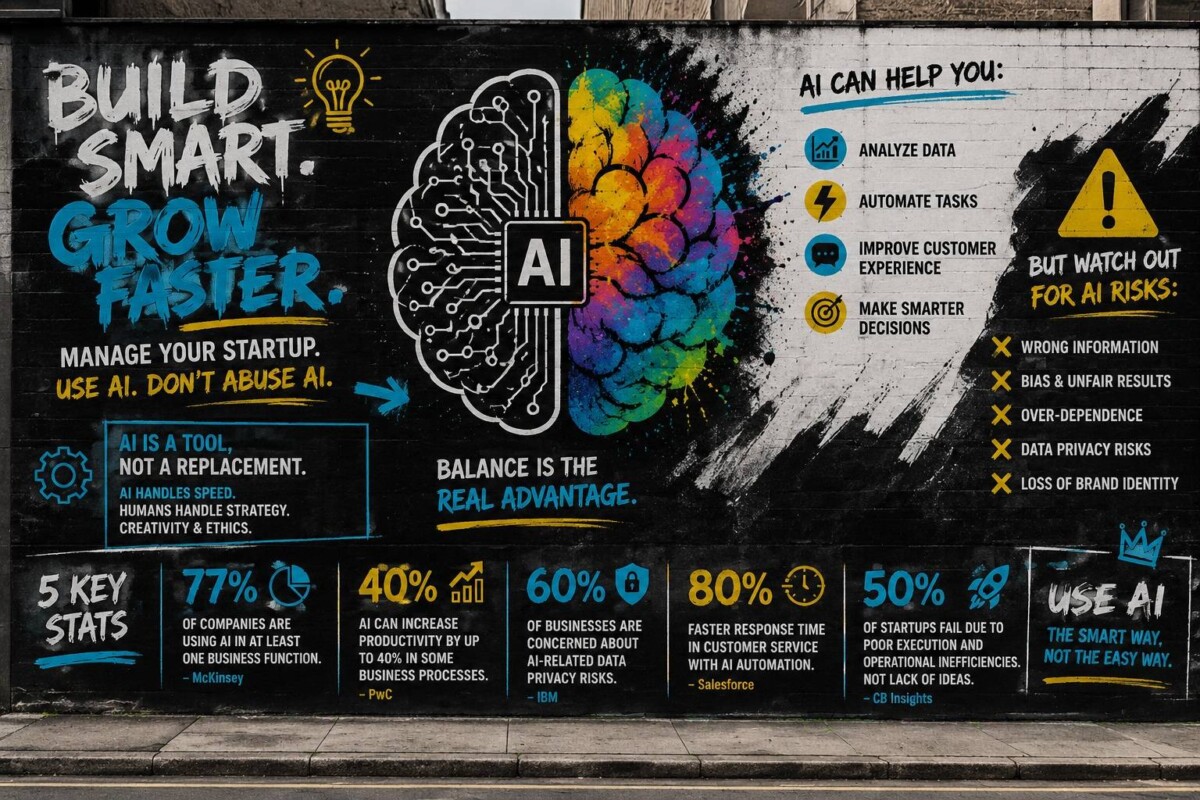
- Up to 77% of companies are already using AI in at least one business function (McKinsey Global Survey on AI).
- AI adoption can increase productivity by up to 40% in some business processes (PwC Global AI Study).
- Around 60% of businesses report concerns about AI-related data privacy risks (IBM Global AI Adoption Index).
- Businesses that use AI for customer service can reduce response time by up to 80% (Salesforce research reports).
- Nearly 50% of startups fail due to poor execution and operational inefficiencies, not lack of ideas (CB Insights analysis).
These numbers show something important:
👉 AI is powerful, but it must be managed carefully—or it can amplify problems instead of solving them.
5. The Real Risk: Losing Your Startup Identity
One hidden danger of AI is not technical—it’s branding.
If you rely too much on AI:
- Your content starts sounding generic
- Your brand loses personality
- Customers can’t feel a “human connection”
- You blend into competitors
In startups, identity is everything. Once you lose it, growth becomes expensive and difficult.
6. How to Build a Strong AI Strategy for Your Startup
Here’s a simple framework used by modern founders:
1. Define AI Boundaries
Decide what AI can and cannot do.
2. Always Add Human Review
Nothing goes live without human approval.
3. Train AI with your brand voice
Don’t use generic prompts—customize everything.
4. Protect your data
Avoid feeding sensitive customer or business data into uncontrolled tools.
5. Measure everything
Track accuracy, performance, and customer satisfaction.
Frequently Asked Questions (FAQ)
1. Is AI necessary for startups today?
Not mandatory, but it gives a huge competitive advantage in speed and cost efficiency.
2. Can AI fully replace employees in a startup?
No. It can automate tasks, but not replace strategic thinking or creativity.
3. What is the biggest risk of AI in startups?
Over-dependence and loss of control over accuracy and brand identity.
4. How can startups safely use AI?
By combining AI automation with human supervision and clear governance rules.
5. Does using AI help startups grow faster?
Yes, especially in marketing, operations, and customer support—but only when managed properly.
Final Thought
AI is not your enemy, and it’s not your savior either.
It’s a powerful engine.
But like any engine, it needs a skilled driver.
Startups that win in the next 5 years won’t be the ones using the most AI…
They’ll be the ones using it the smartest way possible.
