

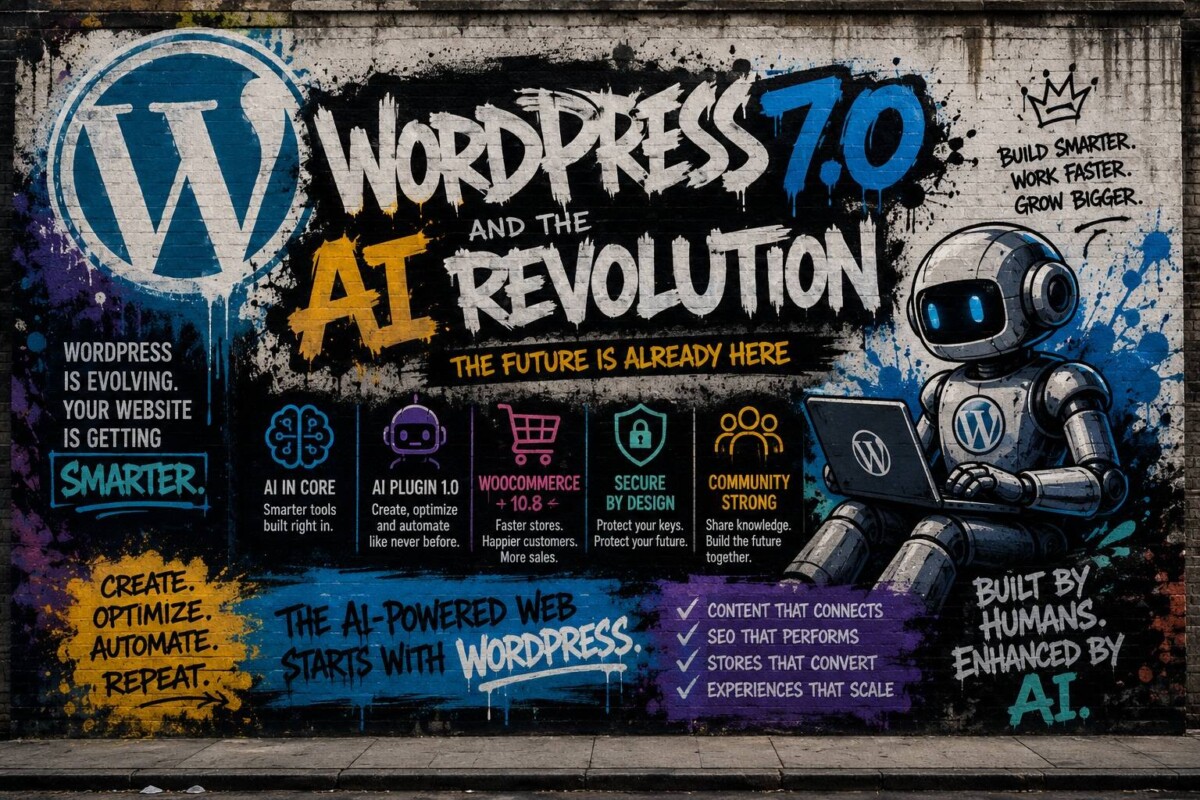
WordPress 7.0 and the AI Revolution: How WordPress Is Transforming from a CMS into an Intelligent Digital Ecosystem
For more than two decades, WordPress has dominated the content management landscape, powering millions of websites across virtually every industry. From personal blogs and corporate websites to large-scale eCommerce stores, WordPress has remained the go-to platform for businesses seeking flexibility, scalability, and ownership of their digital presence.
However, the release of WordPress 7.0 marks a pivotal moment in the platform’s history.
This is not simply another update with design tweaks and performance enhancements. Instead, WordPress 7.0 introduces the foundation for something much larger: a future where artificial intelligence becomes deeply integrated into every aspect of website creation, content management, and online commerce.
The question is no longer whether AI will change WordPress.
The question is how quickly businesses will adapt to this new reality.
WordPress Is No Longer Just a Content Management System
Historically, WordPress served as a framework that allowed users to publish content, manage pages, install plugins, and customize themes. While powerful, much of the work still depended on human decision-making.
With WordPress 7.0, the platform begins evolving into an intelligent operating system for digital businesses.
The introduction of AI infrastructure directly within the WordPress ecosystem signals a dramatic shift in priorities. Website owners can expect future capabilities that go far beyond content publishing. AI-assisted workflows, intelligent content generation, automated optimization, and personalized customer experiences are now becoming core components of the WordPress vision.
This strategic direction positions WordPress to compete in a future where automation and intelligence drive business growth.
The Arrival of Native AI Infrastructure
One of the most significant developments in WordPress 7.0 is the introduction of foundational AI components designed to support future innovation.
The platform now includes AI-related architecture that allows developers, plugin creators, and businesses to build intelligent experiences directly within WordPress.
Rather than relying exclusively on third-party integrations, future WordPress installations may be able to communicate seamlessly with AI services, enabling advanced automation across content creation, customer support, SEO optimization, media management, and analytics.
This infrastructure creates opportunities for developers to build entirely new categories of WordPress products and services.
Why This Matters for Content Creators
Content creation has become one of the most time-consuming challenges for businesses.
Blog posts, product descriptions, landing pages, email campaigns, and social media content require significant effort to produce consistently.
AI integration within WordPress opens the door to faster and more efficient content workflows. Writers can generate outlines, improve readability, create metadata, optimize headings, and develop content strategies directly from their publishing environment.
Instead of spending hours on repetitive tasks, creators can focus on research, creativity, and business growth.
The result is a significant increase in productivity without sacrificing quality.
The Future of SEO in an AI-Powered WordPress Environment
Search engine optimization is also entering a new era.
Traditional SEO often requires multiple tools for keyword research, content optimization, technical audits, and performance monitoring.
As AI becomes embedded within WordPress, many of these processes may become automated.
Imagine a platform that can identify ranking opportunities, suggest internal links, optimize metadata, improve content structure, and generate schema recommendations in real time.
For SEO professionals, this does not eliminate the need for expertise. Instead, it allows specialists to focus on strategy while automation handles routine optimization tasks.
Businesses that adopt these capabilities early could gain a substantial competitive advantage.
WooCommerce Is Becoming Smarter Too
The impact of AI is not limited to content management.
WooCommerce continues to evolve alongside WordPress, bringing significant improvements that directly affect online stores.
The latest WooCommerce updates focus on faster storefront performance, streamlined customer experiences, and improved review collection systems.
These enhancements may seem small individually, but together they contribute to higher conversion rates and stronger customer engagement.
As AI capabilities expand, online stores will likely gain access to personalized recommendations, dynamic pricing strategies, intelligent inventory forecasting, and automated customer support systems.
The future eCommerce store will not simply sell products.
It will actively assist customers throughout the buying journey.
Security Is Becoming More Important Than Ever
While AI creates exciting opportunities, it also introduces new security challenges.
As businesses increasingly connect AI services to their websites, API keys become valuable digital assets.
Poorly configured plugins, weak authentication systems, and insecure integrations could expose organizations to unauthorized access, financial losses, and operational disruptions.
Website owners should begin adopting stronger security practices now.
Protecting API credentials, monitoring usage activity, implementing access controls, and performing regular security audits will become essential responsibilities in the AI era.
Businesses that prioritize security today will be better prepared for tomorrow’s increasingly connected digital environment.
The Hidden Risk Nobody Is Talking About
One of the most interesting discussions emerging from the developer community involves the future of shared knowledge.
For years, developers relied on public forums, blog posts, tutorials, and community discussions to solve problems and share expertise.
Today, many professionals obtain answers instantly through AI assistants.
While convenient, this trend raises an important concern.
If fewer people publish solutions, document discoveries, and contribute to public discussions, the collective knowledge base that future developers and AI systems depend upon may gradually shrink.
Innovation thrives when knowledge is shared.
The WordPress ecosystem has always benefited from an open culture of collaboration, and maintaining that culture will remain critical in the years ahead.
What Businesses Should Do Right Now
Organizations using WordPress should begin preparing for an AI-driven future immediately.
The first step is understanding how AI can enhance content creation, customer engagement, SEO, and operational efficiency.
The second step is evaluating existing workflows to identify repetitive processes that could be automated.
Finally, businesses should invest in learning, experimentation, and strategic implementation rather than waiting for competitors to gain an advantage.
The companies that adapt early will likely enjoy lower operating costs, higher productivity, and stronger market positioning.
Final Thoughts
WordPress 7.0 represents much more than a routine software update.
It signals the beginning of a transformation that could redefine how websites are built, managed, optimized, and monetized.
Artificial intelligence is no longer a separate tool sitting outside the WordPress ecosystem. It is becoming part of the platform’s DNA.
For developers, marketers, store owners, and content creators, this shift presents both opportunities and responsibilities.
The future of WordPress will belong to those who embrace automation, prioritize security, and continue contributing to the open exchange of knowledge that made the platform successful in the first place.
The AI-powered web has arrived, and WordPress is positioning itself at the center of that transformation.
