

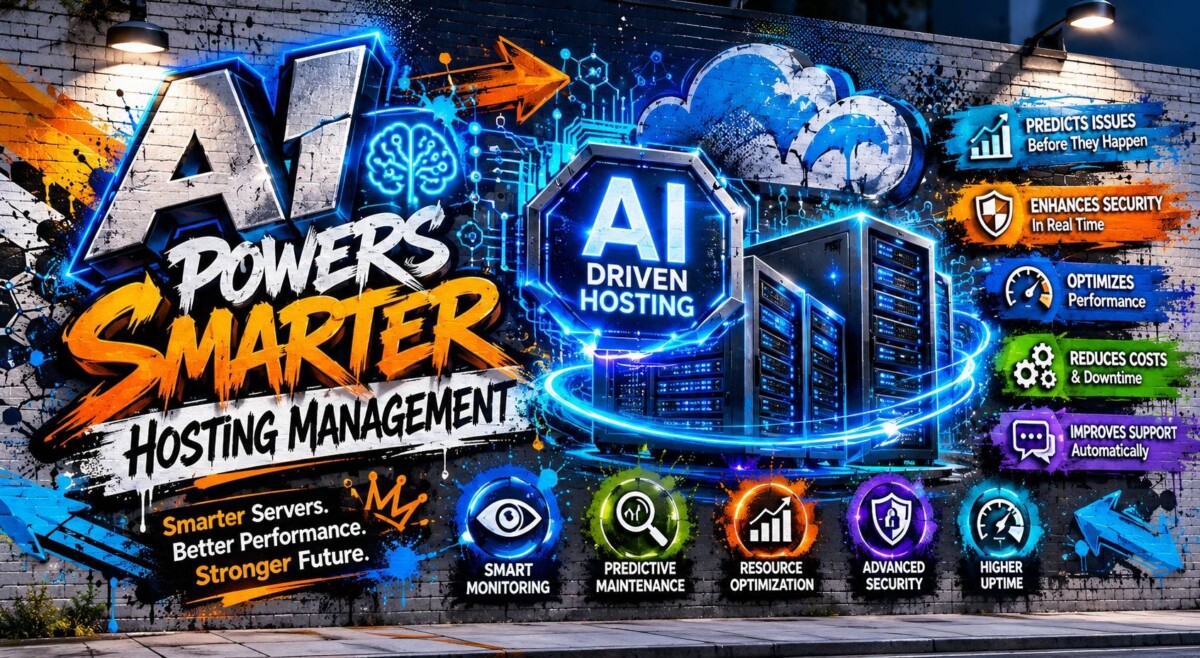
Why Traditional Server Management Is No Longer Enough
The hosting industry has evolved dramatically over the past decade. Modern hosting providers manage thousands of servers, millions of websites, and enormous amounts of traffic every day. Traditional monitoring and manual administration methods are becoming increasingly inefficient as infrastructures grow in complexity.
Artificial Intelligence is emerging as a game-changing technology capable of transforming how hosting companies manage servers, detect issues, optimize resources, and enhance customer experiences. Instead of reacting to problems after they occur, AI enables predictive management that identifies potential failures before they impact users.
The Rise of AI-Driven Server Monitoring
Modern AI-powered monitoring systems continuously analyze server performance metrics, including CPU usage, memory consumption, network traffic, disk activity, and application behavior.
Unlike traditional monitoring tools that rely on fixed thresholds, AI systems learn normal operating patterns and automatically identify anomalies. This allows hosting providers to detect unusual behavior, security threats, and performance bottlenecks with significantly greater accuracy.
The result is faster incident detection, reduced downtime, and more reliable hosting services.
Predictive Maintenance for Hosting Infrastructure
One of the most valuable applications of AI in hosting environments is predictive maintenance. Machine learning algorithms analyze historical server data to forecast hardware failures before they occur.
Instead of waiting for a hard drive, memory module, or power supply to fail unexpectedly, hosting providers can proactively replace components during scheduled maintenance windows.
This approach dramatically reduces service interruptions while extending the lifespan of critical infrastructure assets.
AI-Powered Resource Allocation and Optimization
Resource optimization remains one of the biggest challenges in hosting operations. Many servers operate below capacity while others experience resource shortages during peak demand periods.
AI systems can dynamically allocate CPU, RAM, storage, and bandwidth resources based on real-time demand patterns. This improves infrastructure efficiency and helps providers maximize utilization rates without compromising performance.
Better resource allocation directly translates into lower operating costs and improved customer satisfaction.
Automated Cybersecurity and Threat Detection
Cybersecurity threats continue to increase in sophistication. Traditional security solutions often struggle to keep pace with modern attack techniques.
AI-powered security platforms continuously monitor server activity and network traffic to identify suspicious behavior patterns. These systems can detect malware, DDoS attacks, brute-force login attempts, privilege escalation, and unauthorized access attempts in real time.
By responding automatically to emerging threats, AI helps hosting providers strengthen their security posture and protect customer data.
Enhancing Customer Support Through AI
Customer support is another area where AI delivers substantial benefits. AI-powered chatbots and virtual assistants can resolve common hosting issues, answer technical questions, and guide customers through troubleshooting processes.
This reduces support ticket volumes while providing faster response times. Human support teams can then focus on more complex technical issues that require specialized expertise.
The combination of AI automation and human expertise creates a more scalable support model.
Intelligent Load Balancing and Traffic Management
Traffic spikes can quickly overwhelm hosting infrastructure if resources are not managed effectively.
AI-driven load balancing systems analyze incoming traffic patterns and automatically distribute workloads across available servers. These systems continuously learn from historical trends to improve traffic forecasting and optimize routing decisions.
This results in faster website performance, improved uptime, and more consistent user experiences during high-demand periods.
Cost Reduction Through AI Automation
Operational efficiency is one of the strongest business cases for AI adoption in hosting environments.
By automating routine administrative tasks such as monitoring, reporting, patch management, incident response, and resource optimization, hosting providers can significantly reduce labor costs.
AI also minimizes downtime-related losses and improves infrastructure utilization, generating substantial long-term savings.
The Future of AI in Web Hosting
As AI technologies continue to mature, hosting providers will increasingly adopt autonomous infrastructure management systems capable of making complex operational decisions with minimal human intervention.
Future AI platforms may automatically deploy servers, optimize cloud architectures, predict customer growth patterns, mitigate cyber threats, and continuously improve performance without manual oversight.
Hosting companies that embrace AI early are likely to gain significant competitive advantages in efficiency, reliability, security, and profitability.
Important Industry Statistics
1. More than 80% of IT leaders expect AI-driven automation to play a major role in infrastructure management within the next few years.
2. Organizations using AI-powered monitoring tools can reduce incident detection times by up to 90%.
3. Predictive maintenance systems can reduce unplanned downtime by approximately 50%.
4. AI-based cybersecurity platforms can identify suspicious activity significantly faster than traditional rule-based systems.
5. Companies implementing AI-driven infrastructure optimization frequently report double-digit reductions in operational costs.
6. Automated support systems can resolve over 60% of common customer service inquiries without human intervention.
7. The global AI infrastructure management market is projected to experience strong double-digit annual growth throughout the remainder of the decade.
Frequently Asked Questions
What is AI-powered hosting management?
AI-powered hosting management uses artificial intelligence and machine learning technologies to automate monitoring, optimization, security, maintenance, and operational decision-making across hosting infrastructure.
Can AI completely replace server administrators?
No. AI enhances the capabilities of server administrators by automating repetitive tasks, but experienced professionals remain essential for strategic planning, architecture design, and complex problem-solving.
Is AI useful for small hosting companies?
Yes. Small hosting providers can benefit from AI through improved efficiency, lower operational costs, enhanced security, and better customer support.
How does AI improve server security?
AI continuously analyzes server and network activity, identifies abnormal behavior, detects threats in real time, and can automatically initiate protective actions before attacks escalate.
What is the biggest advantage of AI in hosting?
The greatest advantage is proactive infrastructure management. AI helps identify issues before they affect customers, reducing downtime while improving performance and reliability.
Conclusion
Artificial Intelligence is rapidly becoming a foundational technology in the hosting industry. From predictive maintenance and automated security to intelligent resource allocation and customer support, AI enables hosting providers to operate more efficiently while delivering superior service quality. As competition intensifies and infrastructure complexity grows, integrating AI into server management will no longer be an optional innovation but a strategic necessity for hosting companies seeking long-term success in the American market.
